

Menu
September 2026 Visa Bulletin Preview: What to Expect After August's Historic F2A Jump
September 2026 Visa Bulletin Preview: What to Expect After August's Historic Jump
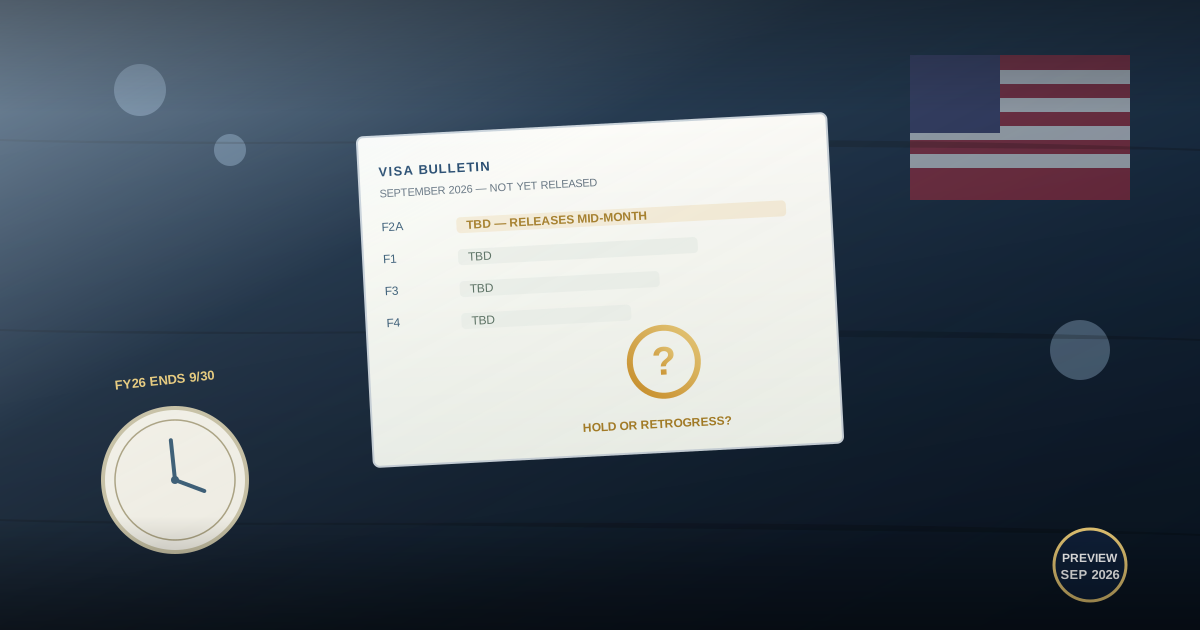
The State Department has not published the September 2026 Visa Bulletin yet — it typically releases in the third week of the month. But after August delivered the largest family-sponsored advance in recent memory, with F2A jumping roughly 19 months in a single bulletin, a lot of people are asking the same question: does that momentum continue into September, or does it reverse?
Nothing below is official. It is a read on historical patterns at the close of a fiscal year, offered so you can plan sensibly while the real numbers are still a few weeks out.
Why September Is Different From Every Other Month
The federal fiscal year ends on September 30. Each family- and employment-based preference category has an annual limit on the number of visas that can be issued, and those limits reset on October 1. That single fact shapes everything about how the September bulletin tends to behave.
By the time August's numbers were set, the State Department had already used most of what it could safely allocate for the year in the categories that jumped — which is precisely why the F2A movement was so large. There was room left in the annual limit, and it had to be used before the fiscal year closed. September is where that math gets tight.
What History Suggests Is Likely
- Categories that moved sharply in August often stall or hold in September. Once a category is close to using its annual allocation, the State Department has little room left to keep advancing dates without overshooting the cap.
- Some categories have retrogressed in past Septembers — meaning the final action date moves backward, not forward — when demand at the newly current dates outpaces the visas still available for the year. This has happened before in categories that saw large summer advances.
- Categories that did not move much in August, like several employment-based categories, tend to stay flat rather than suddenly catching up in the final month.
- October has historically reset the picture entirely. With a new fiscal year and a fresh annual limit on October 1, categories that stalled or retrogressed in September have often reopened or advanced again once the new numbers become available.
None of this is guaranteed. The Visa Bulletin reflects real-time visa demand and government allocation decisions, and both can shift the pattern from what history alone would predict.
What This Means If You Are Near F2A's August Date
If your priority date fell within reach of the July 22, 2026 F2A final action date in August, the practical advice has not changed: if you were current and eligible to file, that window was worth acting on immediately, not waiting to see what September brings. A large advance being paused or pulled back the following month would not undo an application that was already filed while the date was current.
If you have not yet filed and are watching to see whether September holds the same date or advances further, do not assume it will. Plan as if the current window could close, because in past years, similarly large jumps have not carried through to the next bulletin.
What to Do While You Wait for the Official Bulletin
- If you are eligible to file under August's chart and have not yet done so, do not wait for September to confirm it first. Filing is what secures your place — watching the bulletin does not.
- Gather your documentation now so you are ready to file the moment your category is current, regardless of which month that turns out to be.
- Confirm which chart governs your filing — Final Action Dates or Dates for Filing — since USCIS designates which one applies each month, and filing under the wrong one can result in a rejected application.
- If your category retrogresses in September, do not panic. A pulled-back date does not cancel a petition that is already filed and pending; it affects when new filings become possible.
Why Work With an Immigration Attorney Right Now
Fiscal year-end bulletins move for structural reasons that are easy to misread if you are only looking at the headline number. Filing too early, filing under the wrong chart, or misjudging whether a retrogression affects a pending case are the kinds of mistakes that cost real time — and at the edge of a fiscal year, timing is often the entire case.
At Ragheb Immigration Law, we track the Visa Bulletin every month for our Tampa Bay clients, confirm eligibility to file before anyone submits paperwork, and help families move quickly and correctly the moment a visa number is actually available.
Want Help Reading September's Numbers the Moment They Post?
If you have a pending family-based petition and want to know what the September 2026 Visa Bulletin means for your case as soon as it is released, contact our office. We will help you separate what is officially current from what is just historical pattern.
Tags
- Visa Bulletin 2026
- Fiscal Year End Immigration
- Family-Based Immigration
- Priority Dates
- F2A Green Card
- Tampa Immigration Lawyer