

Menu
I-130 vs. I-129F - Which Path to a Green Card is Right for Your Family?
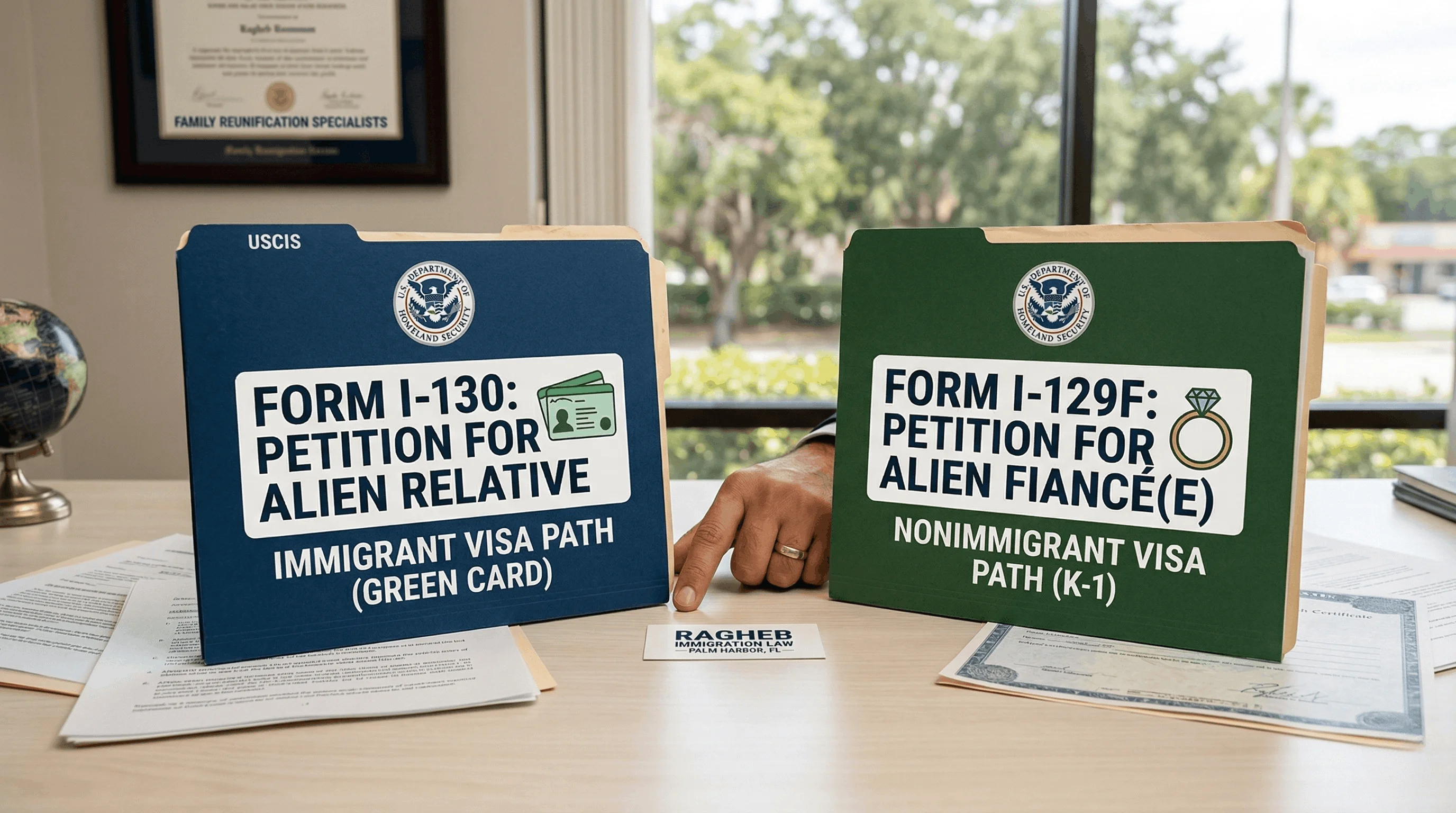
Decoding the Alphabet Soup: I-130 vs. I-129F
For many families separated by international borders, the journey to reunification in the United States begins with a single form filed with U.S. Citizenship and Immigration Services (USCIS). However, choosing which form to file can be confusing. Two of the most common petitions for family-based immigration are the Form I-130, Petition for Alien Relative, and the Form I-129F, Petition for Alien Fiancé(e).
While both forms are stepping stones to obtaining a green card (lawful permanent residence), they serve different purposes and set families on distinct legal paths. It is important to remember that immigration law is federal law, meaning these rules and procedures are uniform across all 50 states.
Form I-130: Petition for Alien Relative
The Purpose: The I-130 is the primary form used by a U.S. citizen or lawful permanent resident (green card holder) to establish a qualifying relationship with an eligible foreign relative who intends to immigrate to the United States permanently.
Key Characteristics:
- Establish the Relationship: The main goal is to prove to USCIS that a valid familial relationship exists (e.g., spouse, child, parent, sibling).
- Step One of two (Usually): Generally, it is the first step. For relatives abroad, the I-130 approval precedes "consular processing" for an immigrant visa. For relatives already present in the US who are not immediate relatives of a US citizen, it precedes the I-485 application for adjustment of status.
- The Important "One-Step" Exception: A critical exception exists for spouses of U.S. citizens who are physically present in the United States after a lawful admission. They are considered "immediate relatives." They can concurrently file the I-130 petition and the I-485 application for adjustment of status (green card) in a single "one-step" process, avoiding consular processing altogether. This is often the most efficient path for eligible spouses in the US.
Form I-129F: Petition for Alien Fiancé(e)
The Purpose: The I-129F is a much more specialized form. It is used exclusively by a U.S. citizen to petition for their foreign fiancé(e) to come to the United States temporarily to get married.
Key Characteristics:
- Temporary Intent (Initially): The goal is to obtain a K-1 nonimmigrant visa. This visa allows the fiancé(e) to enter the US for a specific 90-day period.
- Specific Requirement: The couple must intend to marry within 90 days of the fiancé(e)’s entry into the United States.
- The Adjustment Step: After the marriage takes place within the 90 days, the foreign spouse must then file a separate application (Form I-485) to "adjust status" to lawful permanent resident (green card holder).
The Core Differences: A Head-to-Head Comparison
Choosing the right form depends on understanding how they differ in key areas. Here is a direct breakdown of how the I-130 and I-129F compare across critical features:
Form I-130 (Alien Relative)
- Who Can Apply: U.S. Citizens AND Green Card Holders can file this petition.
- Eligible Relationships: This form can sponsor a Spouse, Child, Parent, or Sibling.
- Visa Outcome: This leads directly to an Immigrant Visa, which is the direct path to a Green Card upon arrival (or concurrent processing in the U.S.).
- Where the Relative Applies: The beneficiary applies either through Consular Processing abroad or, if eligible and already in the U.S. (like the spouse of a U.S. citizen), through One-Step Adjustment of Status.
- Immediate Benefit: If the relative is abroad, there is no immediate benefit; it just starts the process. If they are in the U.S. and eligible, filing concurrently can lead directly to a Green Card.
- Timeline to Green Card: Processing timelines fluctuate heavily. Consular processing can take a long time (often over a year), but the relative receives the Green Card immediately upon entry. The "One-Step" process for eligible spouses already in the U.S. is typically the fastest path to a Green Card overall.
- Associated Costs: This route involves one main filing fee for the petition, followed later by fees for either immigrant visa processing (abroad) or the adjustment of status application (in the U.S.).
Form I-129F (Fiancé(e))
- Who Can Apply: U.S. Citizens ONLY can file this petition.
- Eligional Relationships: This form is used for a Fiancé(e) ONLY (and their eligible minor children).
- Visa Outcome: This leads to a K-1 Nonimmigrant Visa, which is a temporary visa allowing entry for marriage only.
- Where the Relative Applies: The fiancé(e) must apply through Consular Processing abroad (which includes an interview at a U.S. Embassy or Consulate).
- Immediate Benefit: This visa allows the fiancé(e) to legally enter the United States for the specific purpose of getting married (which must occur within 90 days of entry).
- Timeline to Green Card: While the I-129F might allow the foreign partner to physically enter the U.S. sooner than the I-130 consular route, the overall time to actually receive the Green Card can be longer and more expensive. The full process requires the I-129F approval, K-1 visa issuance, travel, marriage, and then filing a completely separate and costly Adjustment of Status
Conclusion: Which Option Depends on Your Unique Family Needs
There is no single "best" answer that applies to everyone. The choice between these two distinct legal paths depends entirely on what your family values most and your specific circumstances.
- Is Your Partner Already in the US? If you are a U.S. citizen and your partner is already here, the Form I-130 with concurrent adjustment of status is almost always the preferred route, as it streamlines the entire process into one main application.
- Is Speed of Entry from Abroad the Top Priority? In early 2026, the I-129F path (K-1 visa) often gets the foreign partner into the United States sooner than the I-130 path via consular processing. If being together physically as soon as possible is paramount, this may be the better choice, even though it requires more steps later.
- Is Simplicity and Cost Efficiency the Top Priority? The I-130 path via consular processing involves fewer steps and lower fees than the I-129F pathway. It leads directly to permanent residence upon arrival, avoiding the intermediate K-1 visa step. If you can tolerate the longer wait at the embassy or consulate, this path can be less complicated and less expensive overall.
- Are You a Green Card Holder? If you are not yet a U.S. citizen, the I-130 is your only option for sponsoring your spouse. You cannot file an I-129F for a fiancé(e).
Navigating these differences is complex, as processing times, fees, and internal USCIS policies continue to evolve in 2026. The right strategic decision can only be made after a full analysis of your unique family dynamics and long-term goals.
At Ragheb Immigration Law, we dedicate our practice to helping families understand their choices and build a legal strategy designed for successful reunification.
Tags
- I-130
- I-129F
- Family Immigration
- Fiance Visa
- Marriage Green Card
- USCIS Forms
- Federal Immigration Law
- Legal Advice